


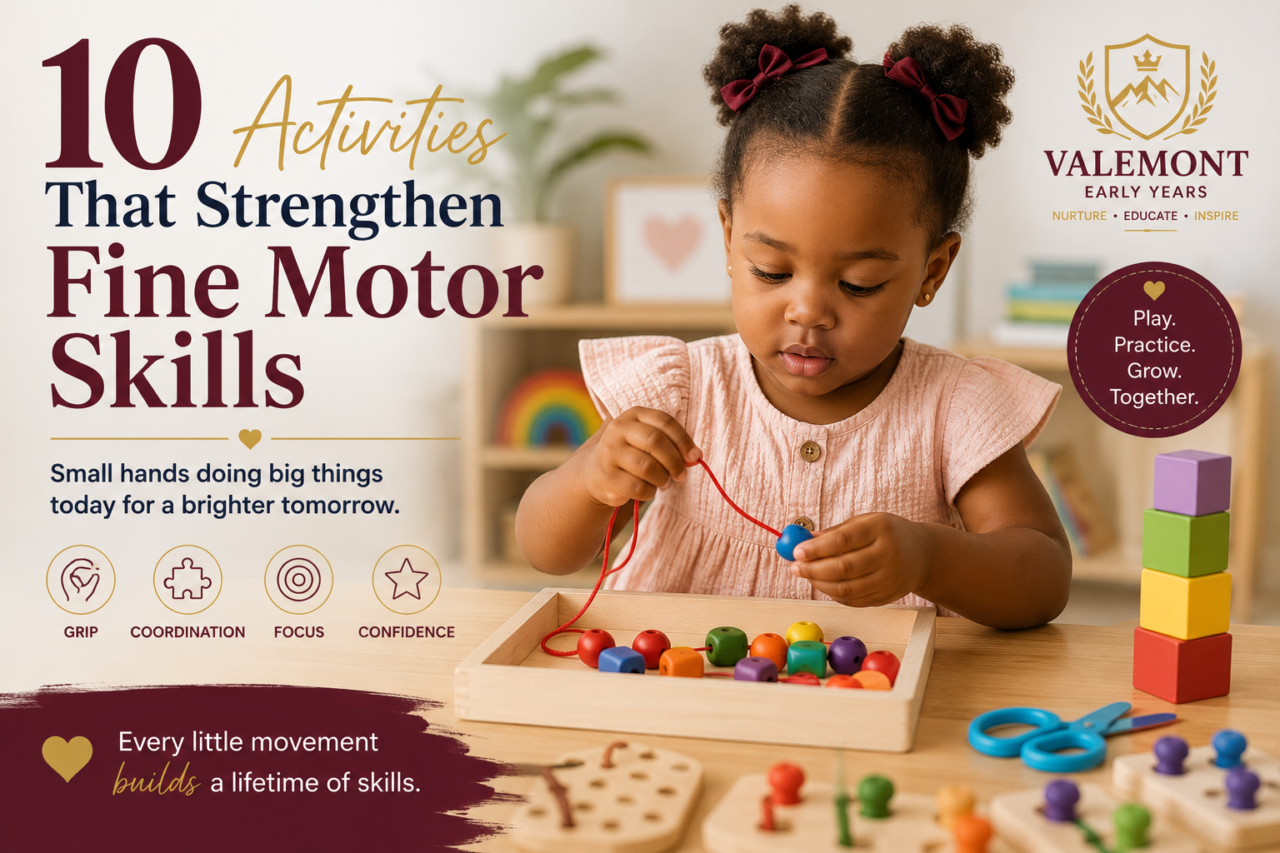
Helping Little Hands Grow Strong Through Play
Have you ever watched a young child spend several minutes carefully picking up a tiny pebble, turning the pages of a book one by one, or proudly attempting to zip up their jacket for the very first time?
To adults, these may seem like ordinary moments. To a child, they are milestones.
Every time children grasp, pinch, squeeze, stack, twist, or button something, they are strengthening what educators call fine motor skills—the small but powerful movements of the hands, fingers, and wrists that make everyday tasks possible.
Long before a child learns to write their name, these tiny muscles are quietly preparing them for success. Fine motor development supports writing, drawing, eating independently, dressing themselves, using scissors, and completing countless everyday activities with confidence.
At Valemont Early Years, we believe these skills develop best through joyful exploration rather than pressure or repetition. The good news is that parents can support this important stage of development using simple activities that fit naturally into everyday life.
What Are Fine Motor Skills?
Fine motor skills involve the coordination of the small muscles in the hands and fingers together with the eyes.
Everyday tasks such as fastening buttons, holding a spoon, turning book pages, drawing pictures, building with blocks, or threading beads all rely on these skills.
Strong fine motor development doesn't happen overnight. It develops gradually through hundreds of playful experiences that encourage children to explore, manipulate, and experiment with different objects.
1. Playing with Play Dough
There is a reason play dough has remained a favourite in homes and classrooms for generations.
As children roll, squeeze, flatten, pinch, and shape the dough, they are giving their tiny hand muscles an excellent workout. Every movement helps strengthen grip, finger control, and coordination while encouraging creativity at the same time.
Whether they are making pretend cookies or creating animals, the learning happens naturally through play.
2. Finger Painting
Finger painting is far more than a fun art activity.
Moving fingers through paint encourages children to strengthen individual finger movements while exploring colour, texture, and creativity. It also develops hand-eye coordination as children learn to control where their fingers move across the paper.
Don't worry about creating perfect artwork—the process matters far more than the finished picture.
3. Building with Blocks
Stacking blocks may appear simple, but it requires remarkable precision.
Children carefully position each block, adjust their grip, and balance objects while learning about size, weight, and spatial awareness.
Every successful tower builds confidence alongside stronger hand muscles.
4. Threading Large Beads
Threading colourful beads onto a lace is one of the best activities for developing hand-eye coordination.
Children must carefully hold each bead with one hand while guiding the lace through the opening with the other. This encourages concentration, patience, and precise finger control.
For younger children, use large wooden beads designed specifically for toddlers.
5. Sticker Fun
Peeling and placing stickers may seem effortless to adults, but for young children it requires careful finger control.
Allow your child to decorate paper, notebooks, or homemade greeting cards with colourful stickers.
This simple activity strengthens the pincer grasp—the ability to hold objects between the thumb and index finger—which later becomes essential for writing.
6. Kitchen Helpers
The kitchen provides countless opportunities for fine motor development.
Simple tasks such as stirring batter, washing vegetables, peeling bananas, pouring water, or arranging fruit on a plate encourage children to practise controlled hand movements while building independence.
Children love feeling trusted with real responsibilities, making these everyday moments especially meaningful.
7. Sorting Small Objects
Invite your child to sort colourful pom-poms, buttons, bottle caps, or blocks into separate containers.
Sorting activities encourage children to grasp, release, compare, and organise objects while introducing early mathematical thinking.
Always ensure that any small objects are age-appropriate and supervised to prevent choking hazards.
8. Turning Book Pages
Reading together offers far more than language development.
Encourage your child to turn each page independently as you read. This seemingly simple action develops finger strength, coordination, and careful control.
Daily reading creates opportunities for learning in multiple areas at once.
9. Water Transfer Activities
Children are naturally fascinated by water.
Provide two small containers and allow your child to transfer water using a sponge, spoon, measuring cup, or small jug.
This enjoyable activity develops wrist control, coordination, patience, and concentration while introducing basic concepts such as pouring and measuring.
Expect a few spills—that's part of the learning process.
10. Practising Everyday Self-Care
Some of the most valuable fine motor activities are simply part of daily life.
Encourage your child to:
- Zip their jacket
- Button their clothes
- Pull up their socks
- Brush their teeth
- Use a spoon or fork
- Wash their hands
Although these tasks may take longer than doing them yourself, each successful attempt builds both independence and confidence.
Children beam with pride when they realise they can do something "all by myself."
Why Fine Motor Skills Matter
Fine motor development influences much more than handwriting.
Children with well-developed fine motor skills often find it easier to:
- Hold pencils correctly
- Draw and colour
- Feed themselves
- Dress independently
- Build with construction toys
- Use scissors safely
- Complete puzzles
- Participate confidently in classroom activities
Most importantly, these everyday successes help children develop resilience and self-confidence.
Learning Happens One Small Movement at a Time
Parents sometimes worry that they need expensive educational toys to support their child's development.
In reality, children learn best through simple experiences repeated consistently.
Every puzzle completed, every page turned, every spoon held independently, and every tower built contributes to stronger hands and growing confidence.
These small moments gradually prepare children for school while helping them become capable, independent learners.
Fine Motor Development at Valemont Early Years
At Valemont Early Years, fine motor development is thoughtfully integrated into every child's daily experience.
Our Montessori-inspired environment encourages children to strengthen their hands naturally through practical life activities, arts and crafts, sensory exploration, puzzles, construction materials, threading activities, early writing experiences, and independent self-care.
Rather than rushing children toward academic milestones, we believe in building the strong foundations that make future learning enjoyable and successful.
Every carefully chosen activity is designed to nurture capable hands, curious minds, and confident children.
Ready to See Learning in Action?
Choosing the right early years environment can make a lasting difference in your child's development.
We invite you to visit Valemont Early Years and discover how our nurturing, Montessori-inspired approach helps children build confidence, independence, and essential life skills through meaningful play every single day.